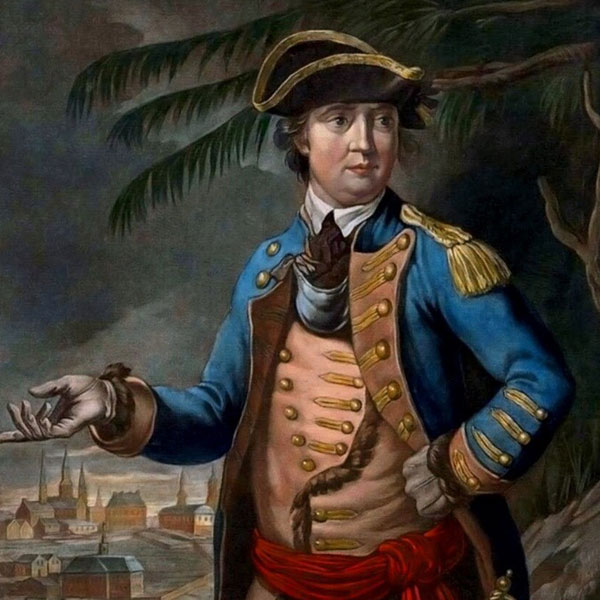
Treasonous Benedict Arnold and Culpeper’s Col. John Jameson
Benedict Arnold is the most famous traitor in American history, in fact the word treason is often synonymous with his name. This most well-known Revolutionary War treason story has strong connections to Culpeper County. Arnold’s betrayal of the Patriot’s cause occurred in September 1780. Although Arnold had many early military Revolutionary War victories, such as capturing Fort Ticonderoga in 1775 and securing a crucial victory at the Battle of Saratoga in 1777, he started to shift his allegiance to the British in 1779. The plot was uncovered in September 1780 when British spy major John André was captured and taken to the highest ranking American officer in the area, Col. John Jameson of Culpeper.
John Jameson was born in 1751 to Thomas and Margaret Jameson in Essex County, Virginia. The Jameson’s were a very distinguished family of Scottish descent. Jameson’s father, Thomas Jameson, was of landed gentry when he moved to Culpeper County in the 1750s when John was just a boy. John’s uncle, Lieutenant Governor David Jameson of Yorktown, Virginia, served from 1780-81 under the governorship of Thomas Nelson Jr. John graduated from The College of William & Mary in Williamsburg, Virginia after which he returned to Culpeper and in 1772 became the Culpeper County Clerk of the Court after the death of Roger Dixon.
In the spring of 1775, under an old oak tree at Philip Clayton’s “Old Field” just west of the town of Fairfax (now Culpeper), Virginia, Jameson voluntarily enlisted with other men, including his brother David, —from Culpeper, Orange, and Fauquier counties—to form the Culpeper Minute Battalion, usually referred as the Culpeper Minutemen. These minutemen were determined to fight the British in the War for Independence. The Culpeper men were the first soldiers raised for the war in Virginia as John Green’s Culpeper Rifle Company was the first to respond to the Virginia Convention’s mandate and the Culpeper Minute Battalion, of which Jameson was designated as captain, became the only fully formed battalion in the critical time of 1775. After forming in October, Col. Patrick Henry requested that the Culpeper Battalion deploy to Williamsburg in defense of Virginia. Jameson led his minuteman company to Williamsburg and by early December, he and his men were engaged in the South’s first battle in December 1775, that of Great Bridge, in which the Patriots defeated Governor Lord Dunmore’s Royal and Loyalists forces. After Virginia’s Patriot forces took Norfolk, Dunmore’s forces fled to their ships. By summer of 1776 Dunmore’s flotilla had given up and sailed toward New York resulting in the end of British governance in Virginia. Virginia declared Independence resulting in directing delegate Richard Henry Lee to introduce a Resolution of Independence in the Second Continental Congress on June 7, The following month, on July 4, 1776 the body approved the Declaration of Independence.
After the British were removed from Virginia and the minute battalion’s service ended, Jameson was elected by the Virginia Convention on June 13, 1776, to be captain of the 3rd Troop of Horse. One of his competitors was Henry “Light Horse Harry” Lee. Jameson took command June 16 as captain in a Virginia regiment of dragoons. He was promoted to major on March 31, 1777, in the 1st Continental Light Dragoons. Jameson was then transferred April 7, 1777, to the 3rd Continental Light Dragoons, where he fought at the Battle of Brandywine Creek later that year. While encamped with George Washington at Valley Forge, Major Jameson was wounded in a skirmish on January 21, 1778. Throughout that year and the next he remained at Washington’s side. He engaged the British at the New Jersey Battle of Monmouth Courthouse, in June 1778, and was promoted to the rank of colonel in August 1779.
In 1780, General George Washington placed key commanders in strategic areas around West Point, New York. As a colonel in the Continental Army, John Jameson was placed in Tarrytown, New York under the command of General Benedict Arnold. Little did anyone know that beginning a year earlier, in April 1779, while serving as military governor of Philadelphia, a disaffected Arnold offered information on American forces to 28-year-old John André, head of the British Secret Service in New York City. It appears that Arnold met André when Arnold was dating his future wife, a British Loyalist named Peggy Shippen. When the British took control of Philadelphia in 1777, Peggy met John André, a charming, well-educated British officer. Peggy married Benedict, a widower with three children, on April 8, 1779 and that is when the disloyalty of Arnold began.
The following year, Arnold took command of West Point, and he secretly offered to surrender the fort to André for ₤20,000 (valued to over five-million dollars in 2026). On September 22, 1780 a final meeting between Arnold and André was arranged to discuss André’s capture of the fort. In the meantime, Arnold had been dispersing men around the fort, not in any fighting order and had been wasteful of the fort’s supplies, ripe for the taking. At their private meeting place André wore his uniform so that he would not be taken for a spy. Arnold met André on the shore near Haverstraw, NY, behind American lines, to talk. There, Arnold gave André papers of West Point, which revealed the placement of troops and other compromising information.
By morning the meeting was over, but the British warship Vulture, which he had earlier arrived, had been forced to move up river, having been fired upon by the Americans. This stranded André with only a dangerous land passage to return to British controlled land. Knowing of the dangers, Arnold signs travel passes for André, using the disguised name of “John Anderson” for André to get back to safety. André decided it was best for him to change out of his uniform and be disguised for the trip. André covered his military uniform with a civilian coat and stashed the incriminating papers into his boot.
During the mid-morning of September 23, a man calling himself “John Anderson” was intercepted along a Hudson River by the three New York militiamen: John Paulding, David Williams, and Isaac Van Vert. Initially, Anderson thought he had been stopped by Loyalists as one of the militiamen had on a Hessian style coat and acted as he was on their side. When Anderson realized they were New York Militia, Anderson tried to convince the men that he was an American officer by showing them the passport Arnold had provided to him. However, the suspicions of his captors were now aroused. They searched him and found papers hidden in Anderson’s boot, including information regarding the defenses of West Point, as well as movements of the American army. Anderson tried to bargain with offers of money and goods, but without success. The militiamen escorted Anderson to the nearest continental army outpost in North Castle, which was commanded by Col. John Jameson, commander of the Second Light Dragoons where Jameson was presented Anderson along with the incriminating papers.
When first presented with Anderson and the documents, Col. Jameson, not sure what to do, first sent a letter to his immediate commander, Benedict Arnold concerning the situation. Jameson had worked with Arnold for many months as his commanding officer and had never expected any treasonous activity from him as they had always had a very professional and responsible relationship. Jameson was also aware that the British had a strong intelligence and propaganda network in place which often tried to divide and undermine leadership in the American Continental ranks with destructive information. Forging documents to look like official American army correspondence was not out of reason. Jameson also knew that his own career would be in jeopardy if he treated Arnold with suspicion and Arnold was totally absolved of guilt.
Col. Jameson sent Arnold a letter by courier informing him of Anderson’s capture and of the incriminating papers found upon him. Hours later, Jameson decided to also send Anderson to General Benedict Arnold to be held at West Point, as Anderson by then had admitted being British General John André. Meanwhile, Jameson held the official passes and West Point plans and was in the process of sending that evidence to General George Washington.
It was about this time that Major Benjamin Tallmadge, head of Continental Army intelligence, arrived at Jameson’s Post and was considerably more suspicious of Arnold’s part in the episode. Jameson was unaware that Tallmadge was quite involved in the undercover “Culper Ring” and that Arnold had been a concern with Tallmadge for a while by then. Tallmadge persuaded Jameson to send a rider to bring André back, which he did. André was retrieved and now under the control of Jameson and Tallmadge.
Meanwhile at West Point, Arnold received Jameson’s note while at breakfast with his officers, made an excuse to leave the room, and rushed upstairs to confer with his wife. Soon after, he made his escape to the Hudson, where he boarded his personal barge and ordered the crew to row him to the Vulture, which had returned to its northerly position on the river. Arnold turned himself over to the ship’s commander, who promptly sailed for New York to deliver Arnold to British General Clinton. An hour or so later, Washington arrived at West Point with his party. Washington had not yet received Jameson’s letter or the incriminating documents, and as yet knew nothing of Arnold’s betrayal or his flight. Washington, however, was disturbed to see the stronghold’s fortifications in such neglect, which was part of Arnold’s plan to weaken West Point’s defenses. He was further irritated to find that Arnold had breached protocol by not being present to greet him.
Finally, several hours later, Washington returned to Arnold’s home and headquarters on the eastern side of the Hudson, where the documents taken from André were presented to him. Washington was visibly shaken and according to Alexander Hamilton, Washington was uncharacteristically quiet, stunned, and deeply hurt by the betrayal of a commander he deeply respected. Washington famously declared, “Arnold has betrayed us! Whom can we trust now?” Like Col. John Jameson, Washington was not privy to information about Arnold’s behavior, even though he was constantly being updated through the “Culper Ring” by Col. Benjamin Tallmadge. Instantly grasping the meaning and significance of the papers, Washington quickly sent men to try to intercept Arnold, but it was too late.
André, meanwhile, was held in South Salem, New York, and then briefly at Arnold’s home, before being transferred across the Hudson to the Continental Army headquarters in Tappan, New York where he was housed in a tavern. Arnold escaped, but André was to be tried as a spy. Something he had wanted to avoid from the very beginning. When Washington read the letter, he asked for the Court of Inquiry to study the incident and decide whether André was acting as a spy.
The British believed that the Americans would not dare to execute a British Adjunct General. There was a trust between sides that generals would be taken as prisoners and not executed. There, as the verdict was decided that André was acting as a spy and operated behind enemy lines while disguising his uniform. As a result, André would be hanged as a common spy instead of executed by a firing squad afforded by officers. All the men on both sides were amazed at the turn of events. The American men admired André for his gallantry as much as the British did for his leadership. No one wanted him to die, but Washington had to be firm and did not back down. André was hanged as a spy at Tappan, New York, on Oct. 2, 1780. He was mourned even by his enemies. In the end, the sequence of events allowed Arnold to escape, but more importantly, the attempt to pass control of West Point to the British was thwarted.
Colonel Jameson remained in the service until after the Yorktown Campaign. After the war, Jameson was awarded thousands of acres of land, some of which was located throughout Virginia, Ohio, and Kentucky. Jameson married Rachel Berrien, daughter of John and Sarah (Fish) Berrien, a wealthy Patriot merchant, on February 25, 1785 in New York City. Rachel died in 1791 and he then returned home to Culpeper, Virginia. Jameson then married Elizabeth Rachel Davenport, daughter of Burkett and Eleanor (Brown) Davenport from Culpeper. Jameson and his new bride settled in town, in their home just west of Main (then known as Coleman) Street and between Stevens and Scanlon Street. Burkett Davenport was a strong supporter of the patriot cause and a leading merchant in Culpeper.
The couple lived in Fairfax where John settled back into the County Clerk position, which he had held since 1772 before the war. Jameson was a member of the Freemasonry chapter in Alexandria, Virginia. He was also a member of the Society of the Cincinnati. John Jameson died on November 20, 1810. Although most sources claim that Jameson was buried at the Culpeper Masonic Cemetery in Culpeper, this is in error as the Masonic Cemetery did not ever exist until ten years after Jameson’s passing. The confusion resulted from a memorial placed in Culpeper’s Masonic Cemetery as a cenotaph, and as a result sources later claim he was buried there. It is certain that Col. John Jameson was buried at Hilly Farm owned at the time of his death by his wife’s Burkett Davenport family.
In the early 1920s, John and Elizabeth (Davenport) Jameson’s grandson, Philip Lightfoot Jameson, identified the burial location of his grandfather, John Jameson, to Judge Lee Thornton, who owned the Hilly Farm property at that time. Since Philip Lightfoot Jameson was the grandson of Col. John and Elizabeth (Davenport) Jameson, there is little doubt that he was told about the exact location of the burial location of his famous grandfather in the Davenport family burial ground. The reason Col. John Jameson was buried at Hilly Farm is as follows. When Col. John Jameson died in 1810, his wife, Elizabeth (Davenport) Jameson buried her husband John in the Davenport Family Cemetery as Elizabeth, was planning on being buried there by her already deceased mother and sister. In understanding this scenario, it makes sense that Col. John Jameson was buried there. Elizabeth’s father, Birkett Davenport would be buried there at his death on August 26, 1817 and Elizabeth was also buried there upon her death on 11 January 1829, however there were no markers made at the time of their deaths for whatever reason. The officer who was first confronted with the treason of Benedict Arnold lies to rest just a few miles north of Culpeper in the old Hilly Farm (now known as Linden Farm) off Chestnut Fork Road in Culpeper County.