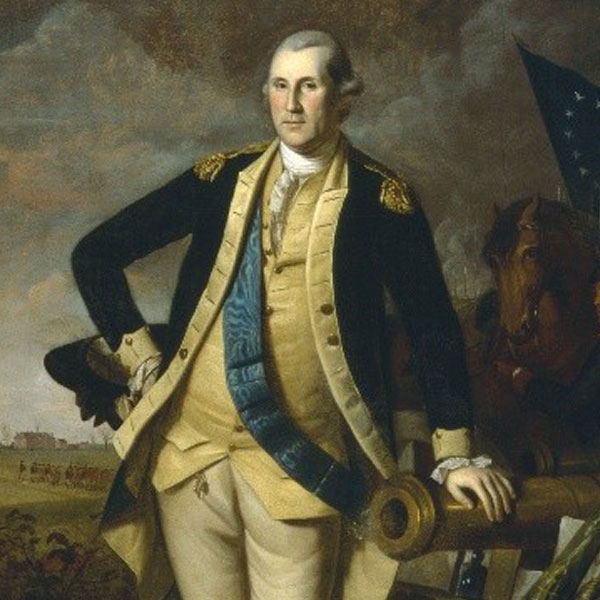
George Washington: His Public Career Started in Culpeper
Written by Jim Bish
Culpeper gave an opportunity to a teen and he turned out to be the most important man of his time. He was the American Revolution’s “indispensable man” and often called the greatest character of his age. As Commander-in-Chief, he held a fragile, under-equipped army together through devastating defeats and freezing winters. He led an army of ordinary men to do extraordinary things, through trials few could have endured except for George Washington’s leadership. Washington faced constant resource shortages and untrained militias, yet his strategic insight, including his attack on Trenton in 1776 and the despair faced during the winter at Valley Forge in 1777-78, kept soldier morale alive during the darkest years. Where did that leadership come from? Much was formed as a teenager in Culpeper.
Washington was born at Pope’s Creek, Virginia, in Westmoreland County on February 22, 1732 to Augustine and Mary (Ball) Washington. There he lived until the age of three when his parents moved up the Potomac River to the Little Hunting Creek Plantation (now called Mount Vernon.) He lived there until just a few months before his seventh birthday when his parents moved just across from Fredericksburg to what was known as the Strother farm, now known as Ferry Farm in December 1738. At that time, George Washington’s uncle, Henry Willis, who married Augustine Washington’s sister Mildred, was Fredericksburg’s most important promoter and certainly played a role in the Washington family’s move there. Washington’s primary residence from that time until becoming an adult was at this former Strother home.
George Washington was influenced early in life by George Hume, county surveyor for both Spotsylvania and Orange Counties. In 1728, Hume platted the original lots of Fredericksburg and later helped establish Fredericksburg’s St. George’s Church, which Washington attended in the 1740’s. Washington’s gift for mathematics and geometry laid the foundation for a career in surveying. After the death of Washington’s father, Augustine in 1743, George was introduced to the influential William Fairfax and his cousin Lord Thomas Fairfax, through his half-brother Lawrence’s marriage to William’s daughter, Anne. Washington’s nature was to act and behave older than his age, especially around those influential landed gentry, such as members of the Fairfax family. Fairfax family members were impressed with the maturity of young Washington and began supporting his many ambitions. One of those ambitions was to become a surveyor of the crown in Virginia.
In 1747, at the age of 15, Washington completed two known training surveys, one at his brother Augustine’s Bridges Creek Plantation and the other at his brother Lawrence’s Mount Vernon Plantation where George surveyed his turnip field. Washington’s breakthrough came in 1748 when he accompanied William Fairfax’s son, George William, and Prince William County’s surveyor James Genn on a surveying expedition of Fairfax’s vast property west of the Blue Ridge Mountains. This expedition exposed Washington to Natives, frontier mapping, and the study of topography by one of the best surveyors in the colony. In early July 1749, Washington aided Fairfax County Surveyor John West in surveying the townsite of Alexandria, Virginia. Supported by Virginia Governor’s council member William Fairfax, Washington received a commission from The College of William and Mary. At the age of 17, with ties to his cousin, Culpeper Court Justice Samuel Ball, Washington took his oath to become the first surveyor of Culpeper County on July 20, 1749.
Although the earliest court order books have been missing since the Civil War, Washington’s place in Culpeper County history has survived. In the 1849, publication Historical Collections of Virginia by Henry Howe (page 237), he states, “it came from one of the books in the Clerk’s office” and then continues, “10th July, 1749, (O.S.) – GEORGE WASHINGTON, Gent., produced a commission from the President and Master of William and Mary College, appointing him to be surveyor of this county, which was read, and thereupon he took the usual oaths to his majesty’s person and government, and took and subscribed the abjuration oath and test, and they took the oath of surveyor, according to law.” And just like that, George Washington became the youngest surveyor in the history of Virginia. This became Washington’s first official public position. Little did anyone know at the time where this public service would take him.
Washington wasted little time in surveying his first requested tract; a 400-acre property for Richard Barnes along a branch of Flat Run. Washington completed this survey on July 22, 1749 with the assistance of marker Robert Slaughter Jr. and chainmen Francis Slaughter Jr. and William Slaughter, sons of Culpeper Justices Robert and Francis Slaughter. This was Washington’s first public service, one that did not end until he returned to Mount Vernon from his presidential tenure in 1797. Washington’s first survey was unique, being the only survey which he signed using his full name while also styling himself Surveyor of Culpeper County. He was very proud of his title as it marked his entry into a professional leadership role. This was the first of approximately 200 professional surveys that Washington completed by 1753. Showing his pride, he used the Culpeper survey as the cover for both of his Book of Surveys in 1749 and 1751.
Washington’s career as a surveyor provided him a highly respected and lucrative profession and allowed him to obtain valuable lands. He acquired a reputation for integrity while developing critical map-making, logistical, and backcountry skills. This knowledge fostered his rise as an effective military strategist during his later wartime experiences. His surveying position gave him the confidence to take on near impossible tasks, which became essential in leading a revolution.
Less than a decade after his service as Culpeper County’s Surveyor, Washington led as a Colonel of the Virginia Regiment during the French and Indian War. Many Culpeper men served under his command at that time including Thomas Slaughter, Lieut.-Colonel and Commander of the Forces from Culpeper; William Green, Major; Francis Kirtley, Captain; John Field, Captain; and William Stanton, 1st Lieutenant. After Washington resigned his service in the French and Indian War he was elected to the House of Burgesses, first from Frederick County and later Fairfax County, between 1758-1774. There he served alongside Culpeper burgesses Thomas Slaughter, Henry Field, William Green, James Barbour, John Field, John Green, Henry Field Jr., and Henry Pendleton. During the Revolution, many former Culpeper leaders of the 1775 Culpeper Military District served under Washington’s command beginning in 1776. Those Culpeper Minutemen leaders turned Continentals who served directly under Washington in the Revolution included John Green, Edward Stevens, Thomas Marshall, John Marshall, Abraham Buford, John Jameson, Gabriel Long, John Chilton, and William Pickett. Washington never forgot Culpeper, identifying his Revolutionary War spy ring “Culper” in coded reference to his first public service of surveying.