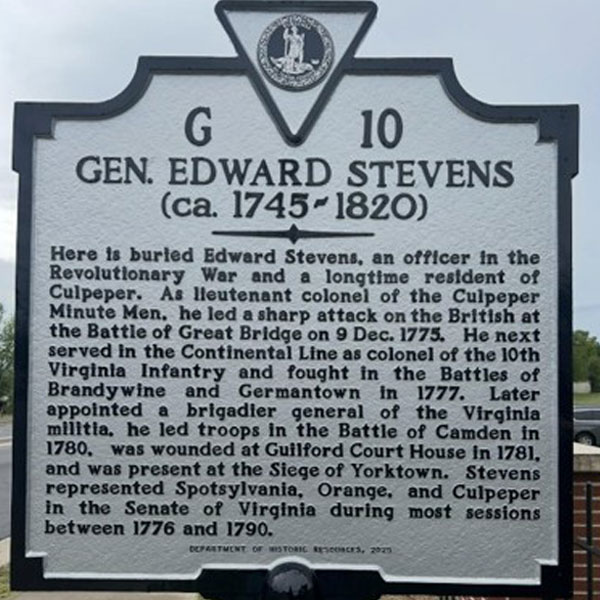
General Edward Stevens and the day Jack Jouett,
“The Paul Revere of the South,” saved him
Written by Jim Bish
Awakened by the sound of Banastre Tarleton’s British cavalry marching towards Charlottesville on the night of June 3, 1781 at his father’s Cuckoo Tavern in Louisa County, 26-year-old Jack Jouett sprang into action. There, Virginia’s legislature and Governor Thomas Jefferson had fled after falling to the British in Richmond earlier. Realizing that Tarleton was intent on capturing them, Jouett set out on the 40-mile midnight ride that would make him famous as the “Paul Revere of the South.” Taking little-used trails through the woods with only moonlight, Jouett raced and arrived in Charlottesville ahead of the British cavalry around 4:30 a.m. Jouett first warned Governor Jefferson at Monticello before speeding off to town to alert the others including Patrick Henry, Benjamin Harrison, and Richard Henry Lee. Thanks to Jack Jouett, Thomas Jefferson and nearly all of the members of the Virginia General Assembly made it safely out of Charlottesville before Tarleton’s cavalry arrived. However, one man, the Virginia senator representing Orange, Spotsylvania, and Culpeper County was almost caught as he had been earlier injured and could not move that quickly. If he would have been caught, Tarleton would not have treated him lightly, as he was the highest ranking military man in the town, a general who had earlier given Cornwallis and Tarleton’s forces fits in the Carolinas. The final act by Jouett was to make sure that this important Virginia general did not get captured.
Edward Stevens was born to John and Mary (Whiting) Stevens in 1745. He grew up to adulthood in Culpeper County, Virginia and in the early 1760s joined the Culpeper County militia where his abilities allowed him to rise to it leading member by 1774. He was aided in his rise to leadership by marrying Grizzel Coleman. Grizzell was the daughter of Robert Coleman who gave the land for the first Culpeper County courthouse and later for the town of Fairfax (now Culpeper). Robert Coleman was an important influence in Culpeper County and he was related to most of the important families in Culpeper County including Pendleton, Clayton, Brown, and Williams. Most of these families migrated together to Culpeper County from Essex County, Virginia where they were also leading families. Robert Coleman’s father, Thomas was the most successful attorney in Essex and built a home which still stands today as the Anderton-Coleman House located in the town of Tappahannock.
Stevens served as the captain of the Culpeper militia before 1775 and when Governor Dunmore removed arms and gunpowder from the Williamsburg magazine in April 1775, Stevens led Culpeper’s Militia to Fredericksburg to await orders. That event eventually was calmed after Dunmore paid for the cost of the gunpowder and the militia returned to Culpeper. For Stevens, his responsive leadership during that episode was a stepping stone for later leadership roles. In September 1775, Stevens was made Lieutenant Colonel of the Culpeper District Minute Battalion. In early October Patrick Henry requested the deployment of the ten-company Culpeper Minutemen and they marched to Williamsburg. There, the Culpeper Battalion was placed under the Second Virginia Regiment and the leadership of Col. William Woodford. As part of the Second Virginia, Steven’s commanded Culpeper’s detachments protecting key locations along the James River. In early November, five companies of the Culpeper Battalion were discharged from their Williamsburg service and the five companies which remained at Williamsburg were led by Lt Col Edward Stevens and Major Thomas Marshall. These companies continued operations south of the James River over the next five months. Time is always critical in warfare and the next five months shaped the campaign in favor of the Patriots and contributed to the complete liberation of Virginia from royal colonial governance during the summer of 1776. Stevens’ Culpeper Battalion was a major contributor to this effort and stands above other military districts in the impact they had on the campaign of 1775 and early 1776. The Culpeper men were most ready when Virginia was least ready to go to war with a competent foe.
On December 5th Stevens led two battalion companies across the Elizabeth River, about five miles upstream or west of the Great Bridge, to attack an enemy unit on the opposite bank operating near the boat guard and occupying a house. On the morning of December 9, 1775 the Culpeper Minute Battalion was detached to two earthworks, again west of the Great Bridge. Those two earthworks created a very beneficial firing position to the bridge, which crossed to the British and Loyalist held Fort Murray. There, the patriots created a strong defensive position integrating the rifle as an effective substitute for cannons. On the morning of December 9th, Steven’s men were armed with rifles that could kill at 250 yards. This defensive location was positioned perfectly to fire into the flank of anyone attempting to cross the bridge or causeway. Return musket fire from the south causeway could not reach the earthworks occupied by the Culpeper Battalion, only the British four-pound canons had the range. Fifty-seven years later, at age eighty-one, and with perfect clarity, Culpeper Minuteman Benjamin Martin described his position that day, “early in the morning the British regulars crossed the bridge and attacked our works. I was at that time on guard off the left of our works.”
As the attack began that morning (December 9) at Great Bridge the men of the Culpeper Battalion had excellent fields of fire into the flank of the advancing column and began to inflict casualties with their rifles. British Captain Fordyce, realizing he advanced into a kill zone, continued to advance south on the causeway. Fordyce’s men continued to advance but men began to fall in greater numbers. The Patriots began to focus on the enemy leadership with their fire and many fell including Capt. Fordyce. With their leaders down, and as the volume of Patriot fire increased, men began to fall back toward the bridge, still in a kill zone, men continued to fall. With the British regulars retreating across the bridge, Lt Col Stevens organized a detachment of the Culpeper Battalion and began to maneuver along the west side of the south causeway. Culpeper riflemen in the trenches on the westside of the causeway provided long range fire that forced the gunners, British marines and sailors, to spike their cannons before abandoning them. The remnants of Fordyce’s assault element were within range of the advancing Culpeper riflemen, and those overwatching from the earthworks. Under pressure, the remaining men in the British assault element, some wounded, made their way into the fort. Joining them were the Loyalists and gunners. In about thirty minutes the Battle of Great Bridge was over, a complete Patriot victory. Woodford kept his headquarters at Great Bridge for the next several days allowing the situation to further develop in his favor. Lt. Col. Stevens led a detachment to Kemp’s Landing on December 11th. Arriving at midnight Stevens immediately began to investigate and examine individuals with Loyalist ties. The Culpeper Battalion had supplied a bloody fire to Dunmore’s Royal and Loyalist forces causing Dunmore to retreat to Norfolk. During the next month Dunmore retreated from Norfolk and eventually fled from Virginia in the summer of 1776. Lt. Col. Stevens remained with Woodford’s command the entire time. This opened the door for Virginia’s legislature to declare independence, being the first colony to do so and requested their Philadelphia delegation to introduce Independence in Congress which Richard Henry Lee complied.
After Governor Dunmore fled Virginia, Stevens was appointed colonel in November 1776 of the 10th Virginia Regiment, of which George Washington assigned to Gen. George Weedon’s brigade on 22 May 1777. Col. Stevens troops covered the retreat and prevented the British from pursuing at the Battle of Brandywine in September 1777. Stevens received the public praise of Washington after both Brandywine and his subsequent performance at the Battle of Germantown. Stevens served as the 10th Virginia Regiment’s leader for a little less than two years, resigning in 1778. This didn’t end Stevens’ involvement in the Revolution. In 1779, he was honored with the rank of brigadier general in the Virginia militia. He took 700 Virginians to join Gen. Horatio Gates’ army in the south. As members of this army, they fought in the disastrous battle at Camden, S.C., where by all accounts they did not fight well. Stevens seriously thought about resigning, but was persuaded to continue his service by the newly appointed southern commander, Nathaniel Greene. Greene had Stevens send out a research party to check on river crossings, depth of water, rocks and where boats could be found. This recon of the North Carolina backcountry allowed for the strategic withdrawal of American forces from South Carolina, which also drew British Gen. Cornwallis farther and farther from his winter quarters in 1781.
The American forces were fortunate that a swollen Dan River ended up stopping the British advance. The Americans were likely in for a drubbing if it wasn’t for the knowledge gained during Steven’s reconnaissance. Shortly after crossing the Dan River, Stevens led his militia at the Battle of Guilford Courthouse on March 15, 1781. Stevens had positioned his militia behind the North Carolina militia. When the North Carolinians broke, throwing down their weapons and running at the beginning of the battle, the British took chase and ran into Stevens’ riflemen, who were positioned behind the North Carolina militia. The Virginia Militia held their position, but during the battle Stevens was wounded in his leg. After the battle, Stevens returned to Virginia to recover. Later that summer, Stevens was in Charlottesville, still recuperating from his wound, but still participating as a member of the Virginia Senate when Jack Jouett rode into town. Because of his wound, Stevens mostly wore loose plain clothes, as he was better able to function in that attire. Stevens, because of his wound, also rode an older and slower, but smoother gaited horse, which at that moment proved a detriment.
Knowing the situation, Stevens found himself in a predicament, but Jack Jouett came to his rescue. Having been dressed in plain clothes and riding an unimpressive horse actually served to Steven’s advantage. Jouett, at six foot four inches and over 200 pounds, was an imposing man. He wore a scarlet coat, riding boots, and a plumed dragoon’s helmet, and was riding his bay mare Sally, said to be “the fleetest steed in seven counties,” if not all Virginia. When Tarleton’s men saw Jouett and Stevens, they incorrectly presumed that Jouett was a high-ranking officer and Stevens an unimportant underling. Jouett knew he and Sally could outrun the British, and he knew General Stevens could not. So, he sent the general off in one direction, while Jouett trotted off in another. Without hesitation, the troopers ignored the man who appeared to be an overweight farmer on a shabby mount and instead took off in pursuit of the man who appeared to be an impressive officer. Tarleton’s men chased Jouett, and he stayed just out of reach from their gunfire. When Jouett realized that he had given Stevens plenty of time to escape, Jouett spurred Sally and they easily outran them. Stevens escaped to safety. Thanks to Jack Jouett, General Edward Stevens recovered from his wounds and commanded the Virginia militia during the Siege of Yorktown that October.
After the war, Stevens served as a member of the state senate representing Orange, Culpeper, and Spotsylvania Counties through to 1790. After the war, Stevens was very involved with the development of Culpeper and Culpeper County. He helped form the local Masonic Lodge and provided much of the funds in support of building the Lodge. Stevens was elected to the American Philosophical Society in 1794, a rare reverence, and the only man from Culpeper so honored. The town of York was renamed to Stevensburg in his honor in 1784. Stevens Street in Culpeper was named in honor of the general. Stevens died on Aug. 17, 1820, and is buried next to his wife in Culpeper Masonic Cemetery, a cemetery he donated from his wife’s family estate of Fairview, which had been the Coleman Family Cemetery.