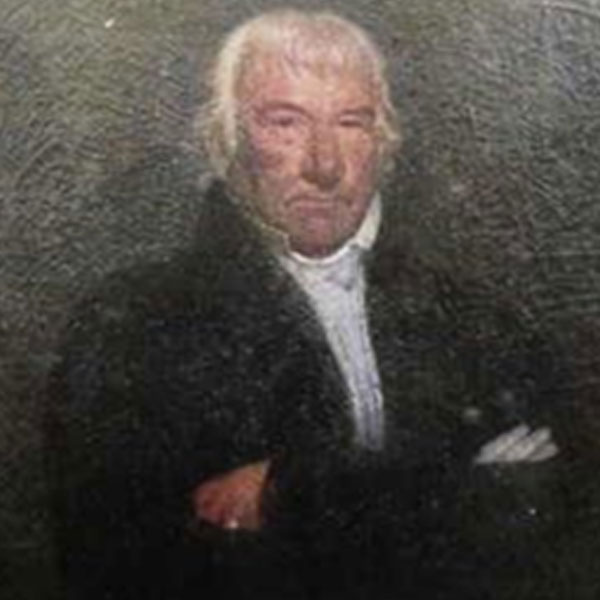
Colonel John Green of Liberty Hall
Written by: Jim Bish
Revolutionary War Major General, and later Governor, “Light Horse” Harry Lee called Colonel John Green “one of the bravest of the brave.” Wounded twice during the Revolution Green, by the conclusion of the war he was disabled for the remaining 13 years of his life. Green died in 1793 and was buried at Liberty Hall at their family cemetery under the Cherry tree, but this would prove not to be Green’s final resting place.
John Green was born in 1730, to Robert Green (1695-1748) and Eleanor (Dunn) Green (1698-1748). Robert Green came to Virginia at the age of 15 in 1710 with his uncle William Duff, Joist Hite, and Robert McKay. Unlikely to inherit, being the youngest, young Robert at age 15, ventured to Virginia with his uncle, William Duff, a Quaker. In 1712, he received the grant of this property that would become Liberty Hall. It is believed that Robert selected this specific property because of the all-weather spring that feeds the Muddy Run below the property. That spring has been the site of various sprig houses that have fed the property for over 300 years. Family lore tells that the Liberty Hall spring, one of 13 on the property, has never run dry even in drought years.
Robert’s Uncle Duff, being a Quaker, did not believe in Drinking, Smoking, Gambling or Fornicating and family Legend has it that Robert named this, his first parcel of land, this plantation, “Liberty Hall” because it was a place at which “A man could be at his liberty…” quite possibly “from Uncle Duff.” This had nothing to do with taxation without representation and other issues of liberty that would surface 60 years later, this was indeed about Booze, Card, Smoke, and Girls. A tradition that is still carried forth to this day at the Hall! Robert built the original house, which is inside the current house in the 1720s. Robert married Eleanor Dunn of Scotland and had seven sons, the red greens of Culpeper. Robert had extensive landholdings in the area, several mills, built roads, and public works in what was then Essex, then Spotsylvania, then Orange and now after 1749, Culpeper County, served in the House of Burgesses and as a vestryman at St. Mark’s Parish Church which established the Little Fork Chapel and later Church just up the road. Robert passed away in 1748 by which time he had amassed well over 40,000 acres but per his will, Liberty Hall passed onto his son John.
It is thought that John Green served in the French and Indian war in the 1750s as he obtained good experiences before the Revolution. In 1756 John Green married Susanna Blackwell, who was from the influential Blackwell family of Fauquier County Virginia. John and Susanna eventually had eight children – seven sons and one daughter. On August 21, 1775 Virginia’s Third Convention passed, “An Ordinance for raising and embodying a sufficient force for the defense and protection of this Colony.” The ordinance created 16 military districts including the Culpeper District, which also included Orange and Fauquier County. This legislation meant that the Culpeper Military District was now tasked with providing manpower of over 650 men including officers. For the first time, Fauquier, Culpeper, and Orange County men were recruiting for war, not against the Native Americans, the French, or the Spanish. This time they were recruiting for war against their own British empire.
As Culpeper readied for war, the Culpeper Military District was to raise one 68-man rifle company in addition to the 500 man minute battalion, rank and file, from the age of 16 to that of 50, to be divided into ten companies plus officers. In the newly formed Culpeper Military District local leaders met and made commitments for recruiting individual companies and decided to meet on September 1st in the central county of Culpeper at the traditional militia muster site of Philip Clayton’s property just west of Culpeper Court House. It seems clear that some of the most experienced riflemen and former militia veterans would make up the district’s needs for the 68-man rifle company that would be incorporated into either Patrick Henry’s 1st Virginia Regiment or William Woodford’s 2nd Second Virginia Regiment. It is clear that John Green was selected by the local committee of safety because of his leadership to recruit and lead the Rifle Company which was demanded by the legislation.
Certainly, rifle competitions were held and most of those who were most skilled were put into John Green’s Rifle Company. There appears to have been enough good riflemen above the 68 needed for the rifle company and they were placed in a variety of the battalion companies. John Green of Culpeper County led the rifle company as Captain with Richard Taylor of Orange 1st Lt. and John Eustice of Fauquier as 2nd Lt. Once John Green’s Rifle Company was completed in only two days, they marched to Virginia’s main staging area of Williamsburg known as College Camp, now known as the Sunken Garden west of the Wren building on William & Mary’s campus.
They were immediately pressed into service guarding the James River crossings that lead into Williamsburg and other Patriot trading routes against Lord Dunmore’s British and Loyalists attacks and takeover. Green’s riflemen quickly became the most important company charged with keeping supply lines open to towns and cities on both sides of the James River including Williamsburg. In a letter from Virginia’s Committee of Safety Chairperson Edmund Pendleton to Thomas Jefferson in November 1775, Pendleton stated, “The five companies of minutemen from the Culpeper Battalion, stationed at Hampton, who have effectively stop’d up the Channel and thrown up a breast work, so as to think themselves perfectly safe against a landing there. The life and Soul of the Corps is Captain Green’s Company of Riflemen from Culpeper who in three Reliefs of about 22 at a time, scour the Rivers, and have in various Attempts, prevented a landing of the enemy.” There was a report that the British ship The Kingfisher challenged Green’s riflemen so that a supply boat with fresh seafood could restock The Kingfisher before departing for Norfolk. Green’s men captured the oyster boat attempting to deliver fresh oysters to the Kingfisher and they dined on oysters that evening.
There is little doubt about the skills of John Green and his efforts aided in the eventual defeat of British and Loyalist forces in Virginia by the late Spring 1776. The Victory of Lord Dunmore’s forces allowed Virginia to become the first state to declare Independence from Great Britain in May 1776, almost two months ahead of the Second Continental Conference in July. With Virginia liberated, Virginia forces focused on helping Washington in the north. Green continued serving with the 1st Virginia, becoming a Major in August 1776. He was wounded at the Battle of Heathcote Hill in Mamaroneck, New York on October 21, 1776, after which he was promoted to Lieutenant Colonel in March 1777. He was promoted to a Colonel with the 10th Virginia in 1778 and transferred to the 6th Virginia in September 1778. Colonel Green later distinguished himself at the battles of Brandywine and Monmouth. Green was assigned to cover the planned retreat of General Nathaniel Green from the battlefield at Guilford Courthouse on March 15, 1781. The Americans had so few adequate troops in any battle that they could seldom stand and fight, so the planning for any battle included a plan for withdrawal. In a later battle, Colonel Green was wounded while storming a breastwork, an injury which disabled him for the remainder of his life. Colonel Green retired in January 1783 from the Continental Army as a Colonel and was one of the original members of the Society of the Cincinnati. He received land warrants for almost 9,000 acres of land in Kentucky for his service in the war. He was commended by the Continental Congress and presented a sword for meritorious achievement. In his will, he claimed to be “sick and weak, but in perfect sense and memory.”
In 1793, Green died at his Liberty Hall Plantation and he was laid to rest in the Liberty Hall burial ground among Cherry trees. This would not be Green’s final resting place. During the Civil War, on May 13, 1864 Arlington National Cemetery was officially established in what is now Arlington, Virginia on the banks of the Potomac River as a final resting place for those who gave the ultimate sacrifice in that war. The graves of eleven Revolutionary War veterans, later reinterred here, confirmed Arlington’s status as a national shrine representing all of the United States’ major wars. The first Revolutionary War burials took place in 1892. Initially buried in a Georgetown, Washington D.C. cemetery that fell into disrepair, the remains of five Revolutionary War veterans (William Ward Burrows, Joseph Carleton, James House, Thomas Meason and Caleb Swan) were relocated to Arlington National Cemetery and buried in Section 1. Since those first five, six more Revolutionary War reinterments have occurred including James McCubbin Lingan, Pierre Charles L’Enfant, John Follin, Hugh Auld, William Russell and John Green.
Because of his status, the Green Family agreed to move the body of Col. John Green and his wife Susanna Blackwell Green to Arlington in 1911. Information about Arlington National Cemetery states that Green is “one of the most distinguished Revolutionary War soldiers buried at Arlington, who saw extensive action during more than eight years of service and he later became an original member of the Society of the Cincinnati.” Colonel John Green also holds another distinction to those buried at Arlington National Cemetery. Of the roughly 430,000 burials at Arlington National Cemetery, nobody buried there died before 1793, resulting in Colonel John Green having earned the title as Arlington’s “Longest Dead Veteran.”